
About two years, working almost every day — and the owner’s own summary of it is the neatest one available: “It took 1 year to do the infrastructure, and 1 year to do the finishes.” That line was posted on February 27, 2021, a week before the first guests toured the building. What follows is the restoration of Oakland’s on 9th laid out as a dated timeline, drawn entirely from the day-by-day posts the owners made while they were doing the work, so you can see what happened when, and how close the whole thing came to not happening at all.
Spring 2019: the first day on the job
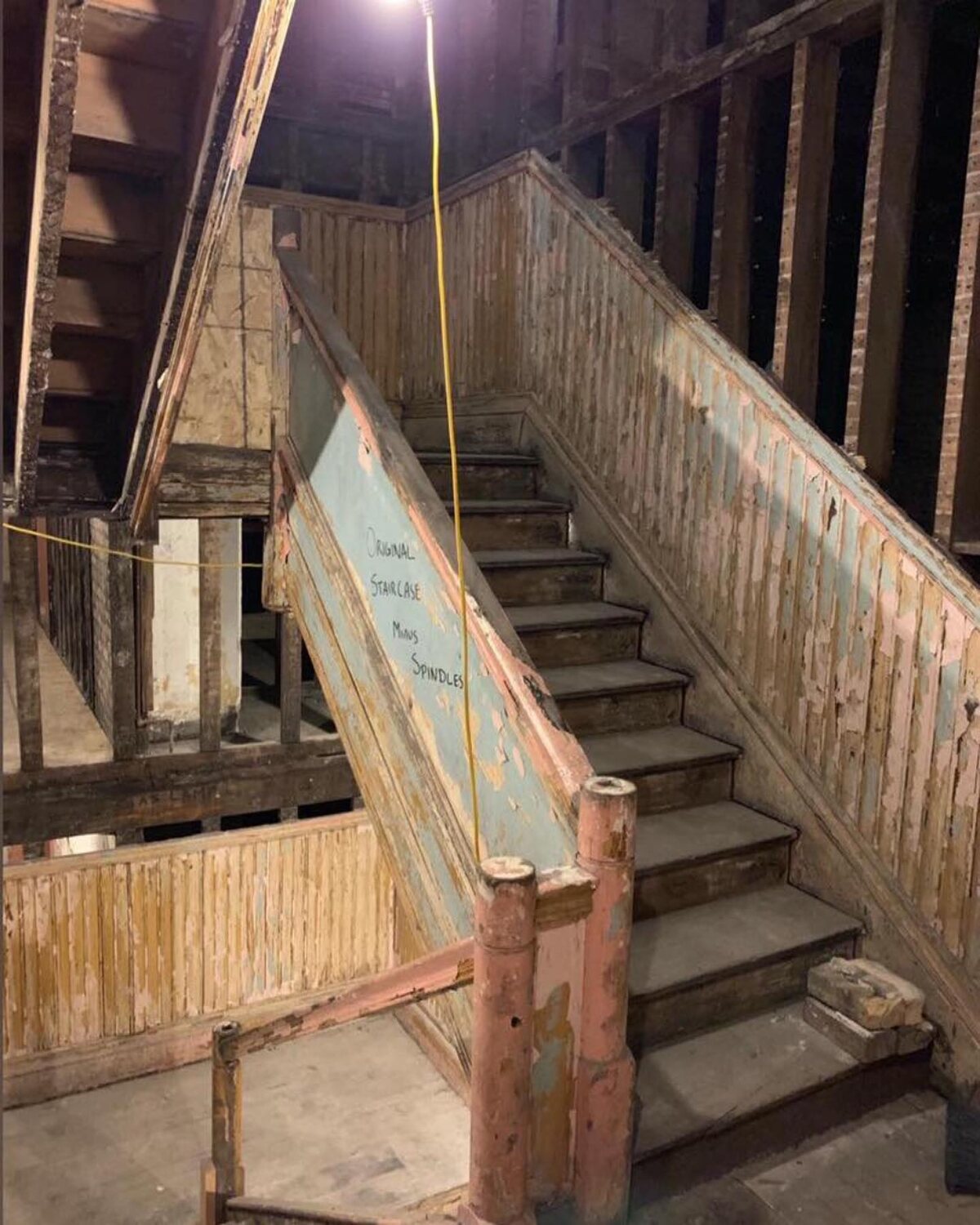
The account’s earliest posts are from the first week of April 2019. The building at 215 South 9th Street had been through a fire in 2016 and had then sat open to the sky, so the “before” is not a tired apartment house but a shell: snow inside the rooms, the grand staircase rained and snowed on for three winters, the boiler destroyed by the freezes. The caption on April 10, 2019 is the whole mood of that spring: “It’s all a little rough at the moment, you just wait…” By June 1 the stained-glass windows were being restored, and a GoFundMe for that work was live by the end of the month. How the building avoided the wrecking ball in the first place is its own story — see Oaklands on 9th: Saved From Demolition.
February 2020: 400 sheets of drywall, and “we had turned a corner”
The first year was the invisible year: structure, plumbing, electrical, the things nobody photographs. The owner marks the turning point precisely. On February 27, 2020, a truck delivered 400 sheets of drywall for the ceilings, each weighing 72 pounds; six people carried them upstairs two at a time, 130 sheets per floor, with pizza to keep them going. Hundreds more sheets followed for the walls. “From this point on we were closing things up and working on finishes.” That is the hinge between year one and year two.
Autumn 2020: 65 windows, two tons of mortar, and a two-week facelift
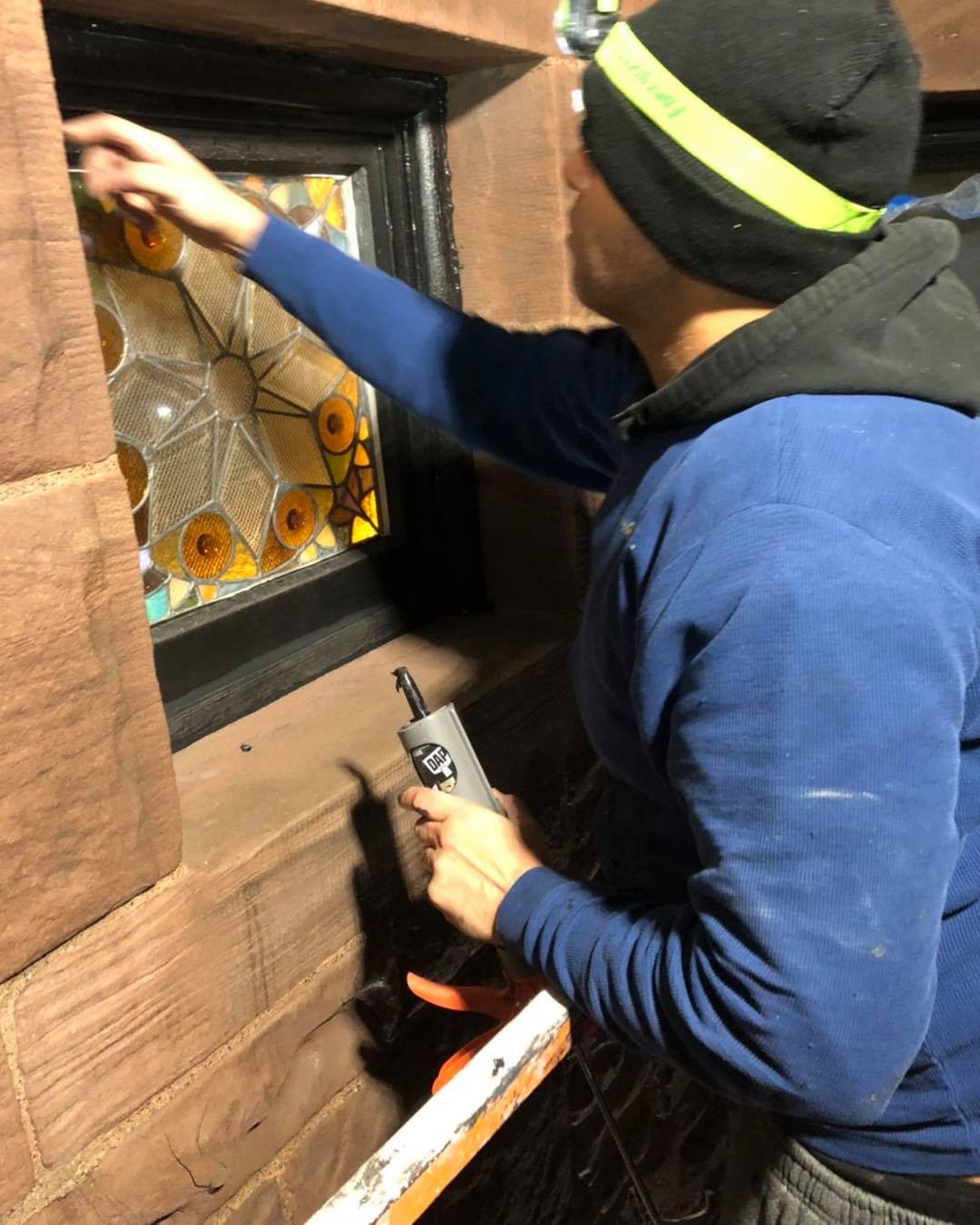
October 2020 is the densest month in the record. On October 5 the owners posted that all 65 windows were finished — one craftsman, Will, had worked on every one of them start to finish over a year and a half, removing the destroyed sashes, restoring the brick moulding and sills, installing and caulking the new units, and for the final six months working seven days a week. On October 11 came the late-night tuck-pointing: every mortar joint in the brick being replaced with a custom-mixed lime mortar, the type originally used in the building, with 4,000 pounds used by that date and the crew working at night to stay out of the neighbours’ way. On October 22 they posted before-and-after photographs of what they called a facelift — “in a little over two weeks we have the whole building a huge overhaul,” brickwork, scraping, painting and prep. The details of that work are in How Oaklands on 9th Was Restored.
November 2020 went into the ground rather than the walls: the parking lot was excavated and regraded, 130-year-old bricks from the original construction turned up in the caved-in window wells, and on November 17 fresh asphalt went down — “a good investment to stop the water from running into the basement.” What else came out of that dirt is in What Was Found Under the Parking Lot.
January 2021: the failed inspection and the found permit
Two January posts show how thin the margin was. On January 11 the owners discovered that the city, expecting the building to be demolished, had sealed over its sewer connection when the main line under 9th Street was relined; three days of robot work in the 1883 brick sewer followed (that story is here). On January 20 the building failed its plumbing inspection: after everything was complete, the system was pressurised and tested with a manometer, and it would not hold because of what the owner called “an ever so minuscule leak.” Every toilet, sink and shower had to come back off to find it, with the re-test scheduled for the next day. Eight days later, on January 28, the fire marshal — “appreciating the history of the Oaklands” — dug into the archives and produced the original building permit: W.P. Burnett, June 20, 1889, a three-storey brick apartment house with a brownstone front, $20,000. The building had an official birthday at last.
The last weekend of January was a final sprint, with the volunteers who had trained on the project coming back for a big push toward completion; who they were, and who else pitched in, is in Who Rebuilt Oakland’s on 9th?
February 2021: heat, carpet, and a lost award
On February 2, 2021, the HVAC inspections passed. Two installers had spent well over a year on the job, replacing the boiler system destroyed in the abandoned winters with a mini-split system that gives each studio its own heating and cooling with no ductwork forced through the 1889 structure, no vents on the historic exterior and no window units in summer. (How the rest of the modern services got in is in this post.) On February 5 the carpet went onto the stairs — the owner admitted the staircase “scared me the most in this project,” and that it came back together with parts donated from the Grand Hotel while remaining mostly original. On February 22 came the one bad day of the month: the building had been nominated for a preservation award, and did not win it. That episode has its own post.
March 1, 2021: the first tour
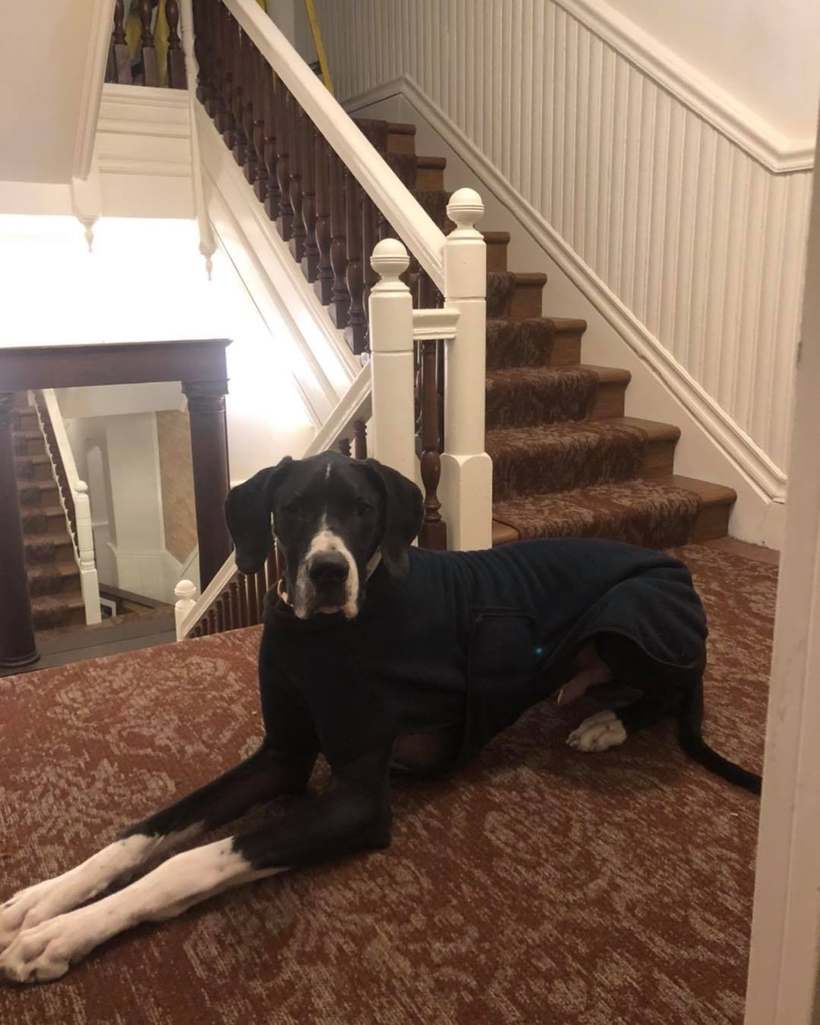
The finish line has a date. On March 1, 2021, the first “Keys to the Oaklands” tour walked through the building — four guests who had bought the commemorative keychains that funded the entry mat, welcomed by the owners’ two Great Danes and signed into a leather guest book a neighbour had donated. A week later, on March 8, the project architect stood on the finished staircase “hugged by historic balustrade, a plush red runner, and dimly lit crystal sconces.” From the first rough April week to that photograph: twenty-three months.
The epilogue: a plaque in 2022
Restorations of this kind rarely have a clean ending, and this one had a coda. In June 2022 the historic designation plaque was unveiled at the building and set in the garden, with public thanks to Council Member Lisa Goodman for the role she played in keeping it standing. On July 26, 2022 the entry mat that the keychain buyers had paid for finally arrived, with the building’s name and the architect’s signature along the bottom. If you’re curious how these projects are supposed to go, the National Park Service’s Preservation Briefs are the standard references for masonry, windows and mortar, and the National Trust for Historic Preservation keeps the broader case for saving buildings like this one.
Stay in the finished building
Every studio you can book today sits inside that timeline: the restored windows, the lime-mortar brick, the mini-split heat, the staircase that nearly wasn’t salvageable. The building is a block’s walk from the downtown skyway system — it isn’t connected to it — and steps from Target on Nicollet Mall, with furnished studios and full kitchens by the night, week or month. Check dates and book online, or call (612) 314-5124 and we’ll find you the right studio.