
Almost everything we’ve written about bringing an 1889 brownstone back to life happens above ground — sixty-five windows, four thousand pounds of lime mortar, a salvaged staircase. The three strangest days of the whole restoration happened under the middle of 9th Street, and they involved a robot.
A connection nobody expected anyone to need again
In January 2021, deep into the renovation, nothing would drain. The plumbing inside the building was brand new; the problem was outside it.
At some point before we bought the place, the city had slipped a new liner inside the old main sewer under 9th Street — a routine, trenchless way to rehabilitate an aging pipe. When crews line a sewer, they go back and cut each building’s connection open through the liner. Ours never got cut. The Oaklands was sitting empty and headed for the wrecking ball, and its connection was simply sealed over, as though nobody would ever need it again.
We’ve written before about how close this building came to demolition, but a sealed pipe is that story told in concrete rather than meeting minutes. Somebody’s map said this address was finished.
What the old plan sheet actually says
To find our connection again, the crew pulled the city’s original plan for this block — a beautiful document that answers a question we’d never thought to ask.
The sheet is labeled 9th St. S., 2nd Ave. – 3rd Ave. S., and beneath that: 410′ of 36″ brick egg. In the margin is a cross-section of the pipe, drawn in red — not a circle but an egg standing on its narrow end, thirty inches across and forty-five inches tall, built of brick. And stamped across the top of the drawing: BUILT 1883.
Eighteen eighty-three — six years before this building went up, and the same year a young MIT graduate named Harry Wild Jones arrived in Minneapolis and opened the practice that would produce the Lakewood Cemetery chapel and, eventually, the Richardsonian Romanesque front you walk past on 9th Street.
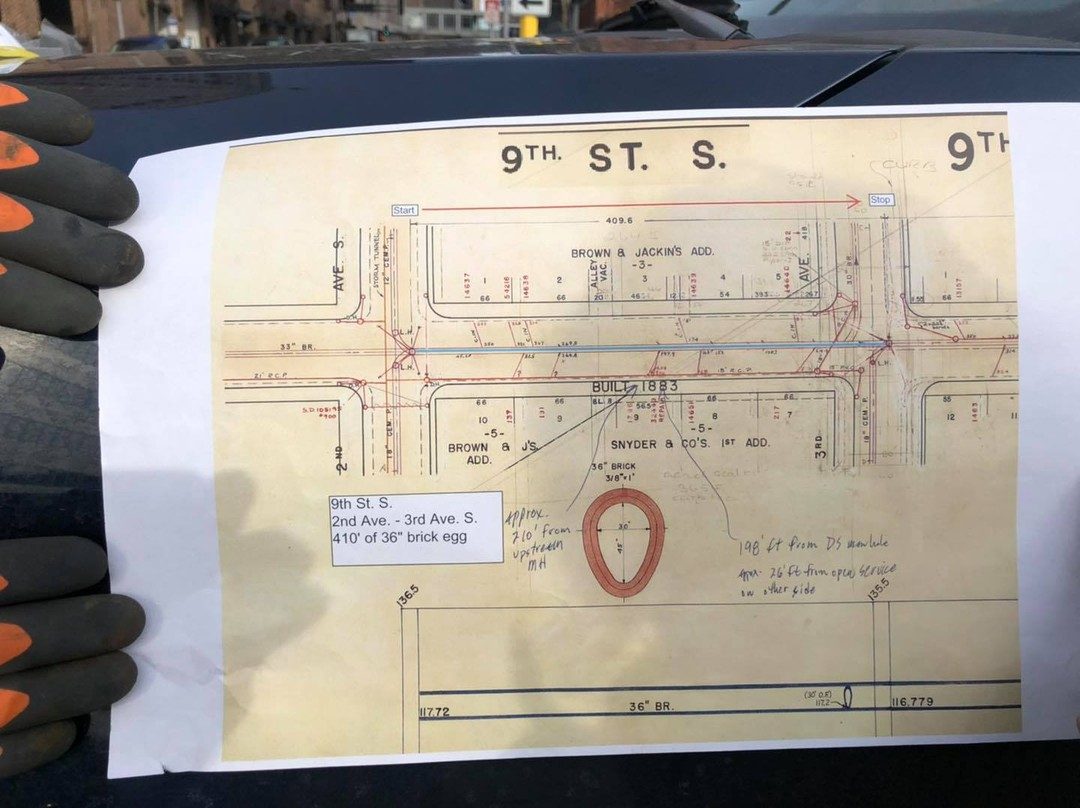
That egg shape wasn’t decoration. Per the City of Minneapolis’s own history of its drainage systems, 124 miles of egg-shaped sewers went in here between 1870 and 1895: the narrow bottom kept everyday flow moving fast enough to scour itself clean, the wide top handled storm surges. Large pipes like ours were laid up in brick, and the city didn’t switch to reinforced concrete until around 1930.
The timing makes sense once you know what the 1880s were like here. Minneapolis began that decade with barely two and a half miles of sewer and, as the Historyapolis Project documents in its post on the city’s 1889 sewer map, a run of typhoid epidemics to go with it. The city built furiously in response: more than sixty miles by 1890. Our block got its pipe in 1883, and the building plugged into it six years later.
Three days, a dye test, and a robot
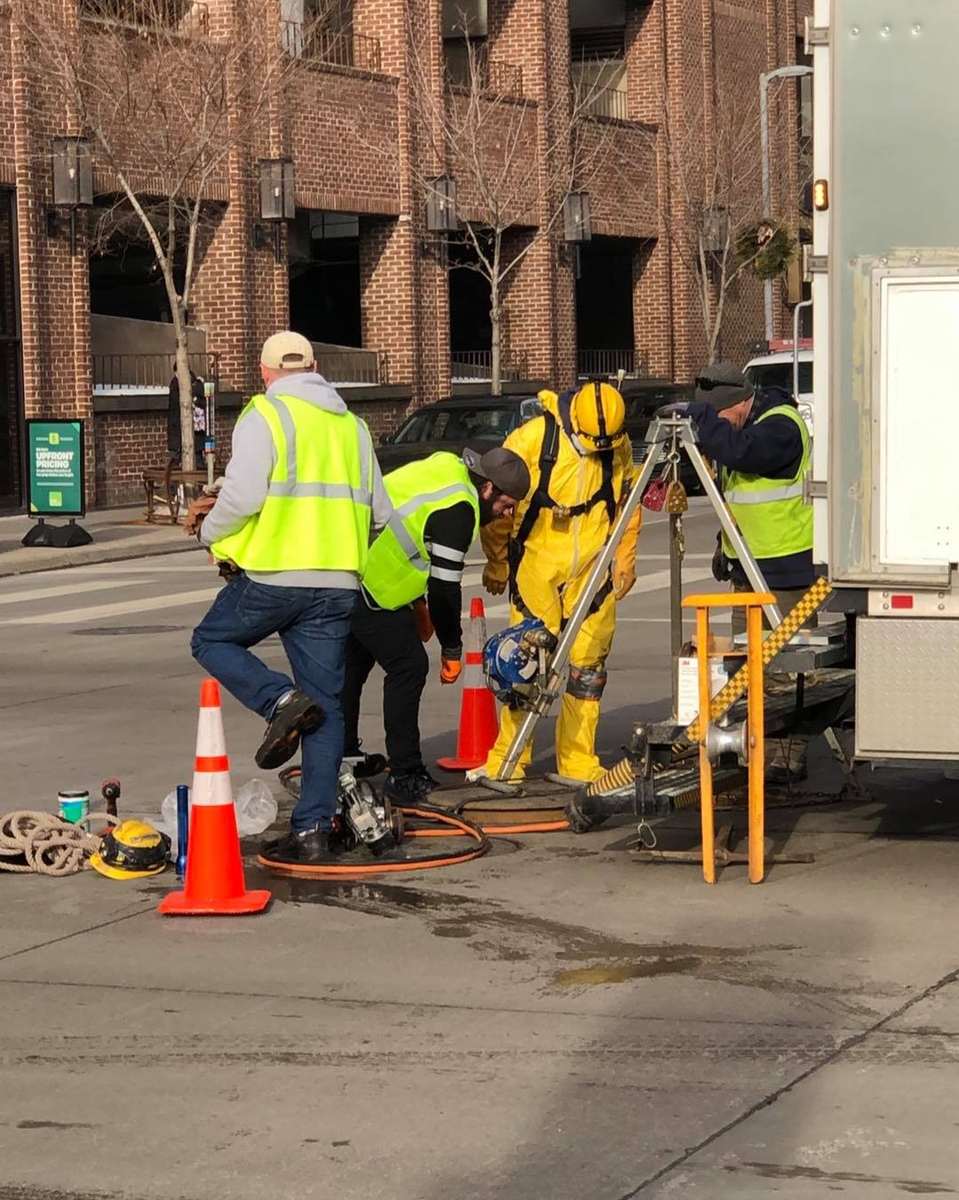
The city was out the same morning we called, which we’ve never stopped being grateful for. Finding a sealed connection is harder than it sounds. In Minneapolis most sanitary mains run down the center of the street, with each building’s lateral running out to meet them. With the liner in place, ours simply didn’t show up.
Day one: a camera truck, and dye poured into our water so the crew could watch for color arriving in the pipe. Day two: a crawler robot sent down the main to hunt for the buried stub, and once it was found, a technician who opened it by hand with a sawzall — enough to get flow moving. Day three: the robot went back down with a router to clean up the cut.
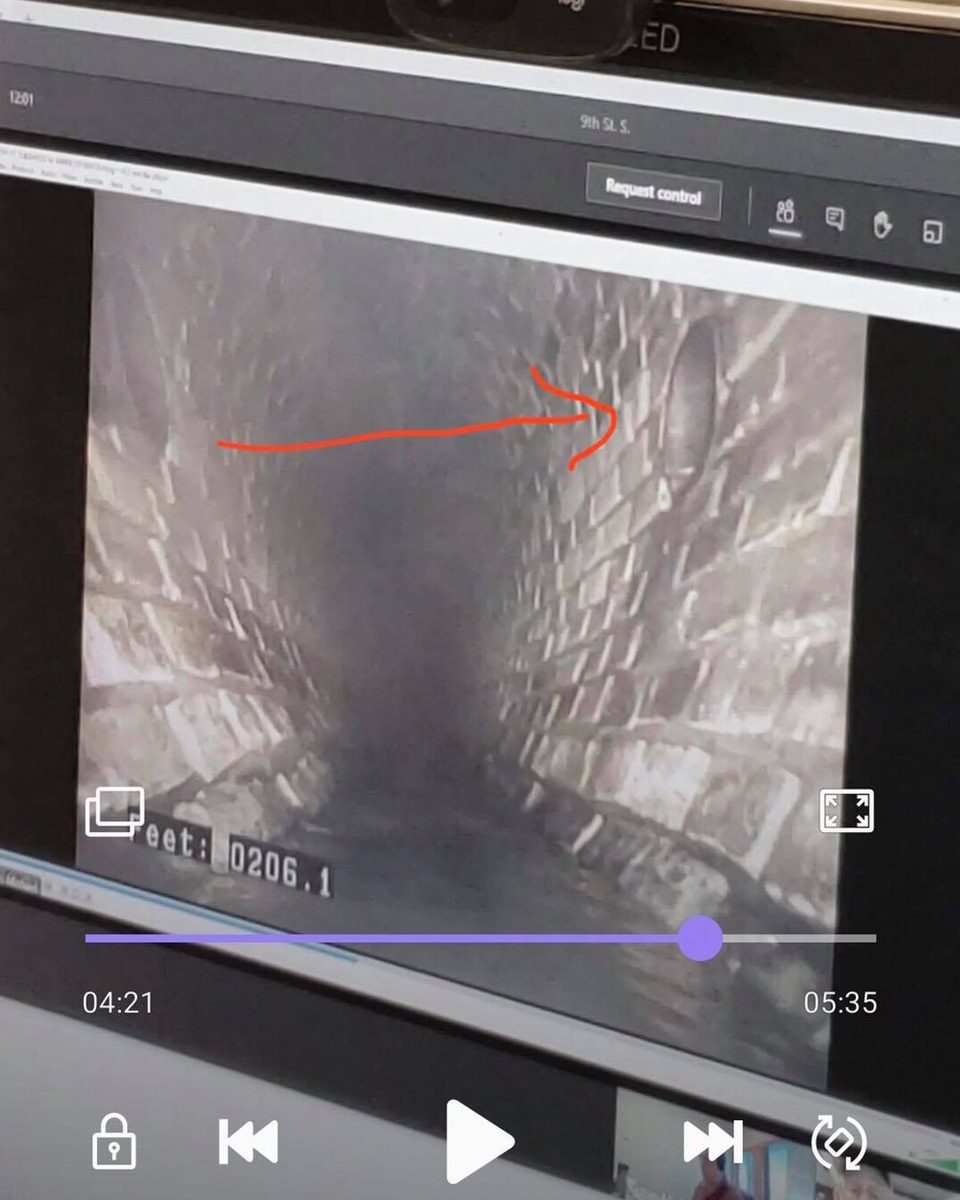
The photo above is the one we still show people: the inside of the 1883 pipe before the liner went in, red arrow marking the Oaklands. Brick, laid by hand, still doing its job.
Why a hotel tells you about its plumbing
Because it’s the truest short version of what this building is. Nothing here was inevitable. The staircase was salvaged, the mortar mixed by hand to an 1889 recipe, and the drain line argued back into existence by a crew standing in a cold street with a robot.
What you get now is a furnished studio with a full kitchen, free laundry, WiFi and utilities included, and no lease — a night, a week, or a month. Target on Nicollet at 9th, the Armory, Orchestra Hall, Target Center, U.S. Bank Stadium and Target Field are all on foot, with HCMC and the U of M medical campus close by. New to downtown? Our guide to how the skyway system works is the fastest way to get oriented.
If old Minneapolis buildings are your thing, we keep two others: 300 Clifton and the Pillsbury Club on Park Avenue — and Minneapolis Trolley Tours covers a good deal of the city built in the same decade as that sewer.
Come stay in the building that got reconnected. Check dates and book a furnished studio at Oaklands on 9th, or call us at (612) 314-5124 — we’re happy to talk through which studio suits your stay.
Keep reading: the systems we hid behind that brick are only half the story — here is what is actually included in a furnished studio at Oaklands on 9th.