
Guests notice it on the second or third night, usually. You reach up to switch on the light in your studio, and it is not the light you expected. It is not a builder-grade dome from a big-box store. It is a real fixture, with real weight to it, and the studio next door has a completely different one.
That was on purpose. When Oaklands on 9th was brought back from a burned-out shell between 2019 and 2021, the crew went with antique light fixtures, professionally restored, throughout the entire building. Every unit got a unique light with its own story. It is one of the small decisions that makes a stay here feel less like a hotel room and more like living somewhere.
Minneapolis was a very early electric city
There is a good reason lighting is a fitting way to tell this building’s story. Downtown Minneapolis was one of the first places in the world to be lit this way. On September 5, 1882, the Minnesota Brush Electric Company switched on a small station on Upton Island, just below St. Anthony Falls, and produced the first centralized hydroelectric power in the United States — beating Appleton, Wisconsin by twenty-five days. The next year the company raised a 257-foot light mast over Bridge Square and installed eight electric street lamps downtown, mostly to prove to a nervous public that electric light would not burn the city down.
Oaklands on 9th went up in 1889, seven years into that experiment, when most homes and businesses in the city were still running on gas. Minneapolis did not turn off its last gas street lamp until 1924. So this brownstone belongs to the exact moment when good lighting was still a thing worth advertising.
Sourced one at a time, restored one at a time
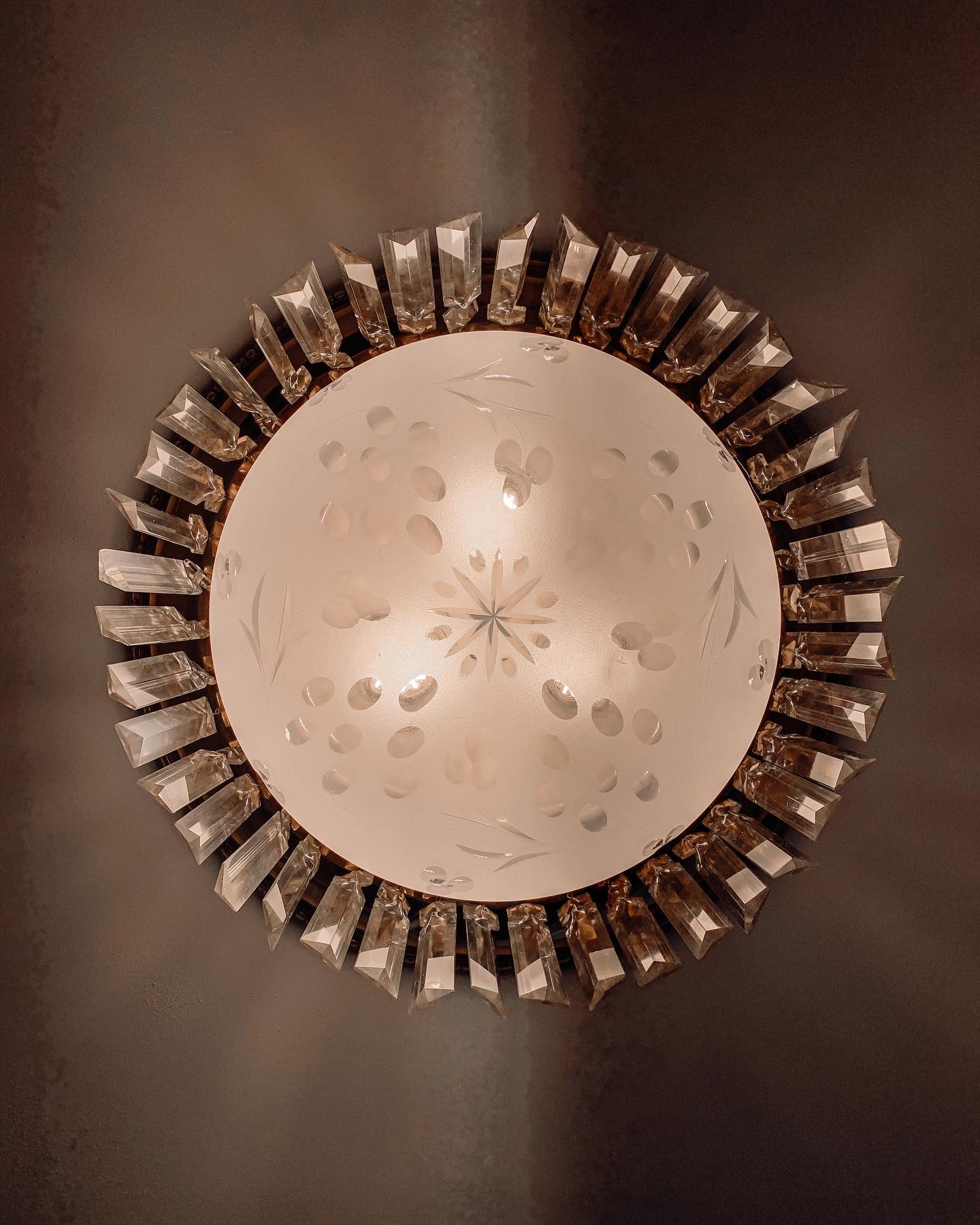
Buying twenty-four matching fixtures would have been faster and cheaper. Instead the fixtures were collected individually and sent out for professional restoration — rewiring, cleaning, replating, sorting out missing glass. Some are heavy cast brass with alabaster and milk-glass globes. Some are flush-mount ceiling fixtures with etched glass shades ringed by faceted prisms. One is heavy enough that hanging it was a two-person job.
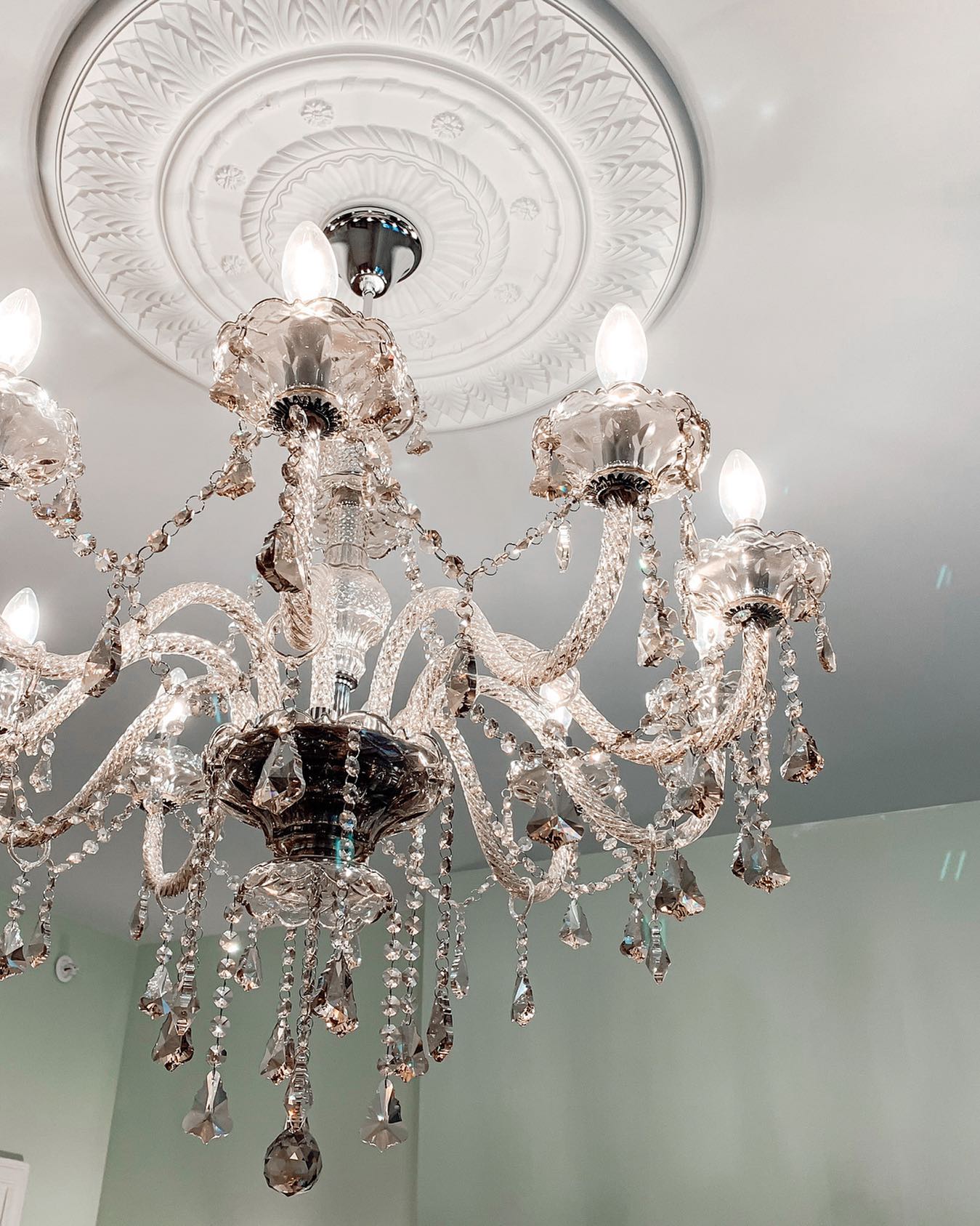
In the common areas the approach was the same. New chandeliers went up in the stairwell and on the landing, and crystal sconces line the stairs above the historic balustrade and the red runner. If you drive down 9th Street after dark you can see them through the windows.
The rest of the wiring behind all of it is thoroughly modern. Power comes into the building through the original coal chute and now runs mini-split heating and cooling, induction cooktops, instant hot water, Wi-Fi and Ethernet, keyless locks, and all-LED lighting. Old glass, new everything else. We wrote about that side of the project in how the building was restored — 65 windows, 4,000 pounds of lime mortar, and a salvaged grand staircase.
Why any of this matters when you are just looking for a place to stay
If you are here for three weeks on a contract, or two months while your house is repaired, or a semester of clinicals, the details of the room stop being decoration and start being your life. A warm pool of light over the table where you eat dinner alone after a long shift is not a small thing. Neither is a hallway that feels cared for at eleven at night.
The practical side is straightforward: furnished studios with full kitchens, month to month or a single night, no contract. WiFi, all utilities, heat, and laundry are included, and some units are pet friendly. There are three tiers — Good, Better, and Best. And you are at 215 South 9th Street, a walk from the Skyway, Target on Nicollet Mall, the Armory, U.S. Bank Stadium, Target Center, Target Field, and Orchestra Hall, with Hennepin Healthcare and the U of M Medical Center close by.
Curious about the rest of the building’s story? Try the 1889 Richardsonian Romanesque front or the people who built and rebuilt it, including architect Harry Wild Jones — whose own house is a designated City of Minneapolis landmark. The city’s heritage preservation program is a good rabbit hole if old buildings are your thing.
And if you catch the preservation bug while you are in town: our sister property 300 Clifton is a restored Gilded Age mansion near Loring Park, the Pillsbury Club is another Minneapolis mansion worth knowing about, and Minneapolis Trolley Tours will drive you past a lot of them in an afternoon. Meet Minneapolis has the rest of the city covered.
Come see which light you get
We cannot promise you a specific fixture — that part is luck of the draw. We can promise it will be a real one. Check dates and book a studio, or call us at (612) 314-5124 and we will help you find the right fit.
Keep reading: once you have admired the fixtures indoors, head up a level outdoors — here is how the Minneapolis Skyway works, including its hours and the event nights it stays open late.