
Guests checking in at 215 South 9th Street usually pause on the sidewalk before they come up the steps. Downtown Minneapolis is glass and steel in nearly every direction — and then there is this: three stories of rough, rust-colored stone with a deep round arch cut into the front of it.
People ask us what the style is called. It has a name, and the name explains almost everything about how the building looks.
Richardsonian Romanesque, in one paragraph
The City of Minneapolis lists the building’s architectural style as Richardsonian Romanesque — named for the Boston architect H. H. Richardson, whose heavy, arched masonry became the look of serious American buildings in the 1880s. The vocabulary is easy to learn: stone left deliberately rough on its face, wide round arches instead of flat lintels, window openings set deep into thick walls, and short columns with carved capitals tucked into those openings.
It was a style meant to look permanent. In this case it more or less was. The building has outlived a streetcar boom, a long stretch as a hotel, a fire, and a demolition permit.
Harry Wild Jones designed it in 1889
The architect was Harry Wild Jones, who arrived in Minneapolis in 1883 by way of Brown and MIT and then spent nearly fifty years shaping the city. If you have ever stood under the mosaic dome of the Lakewood Cemetery Memorial Chapel, you have been inside his best-known room. His own turreted house in Tangletown, Elmwood, is a Minneapolis landmark in its own right.
The original permit was pulled on June 20, 1889 by owner W. P. Burnett: a three-story brick apartment house with a brownstone front, $20,000, expected to be finished by that September. What made it unusual was not the budget. The City’s landmark profile notes the Oakland was one of the first multi-family dwellings in Minneapolis — and the first to put every unit behind a single shared front door. Until then, each apartment generally had its own exterior entrance.
The arch you walk under, in other words, is a large part of why the building matters.
Four things to look for from the sidewalk
- The arch. Wide and round, cut through the stone rather than applied to the surface — the single clearest marker of the style.
- The face of the stone. Rock-faced blocks, left rough on purpose, played against smoother bands and carved panels. The rough and the smooth are both intentional.
- The window openings. Set deep into the wall, so they read as shadows rather than holes. All 65 were rebuilt during the restoration, sills and brick molding included.
- The marker in the garden. The Oakland Apartments received local landmark designation in 2019, for its exterior. The marker sits just inside the fence.
Inside: a hallway timeline and a signature at the door
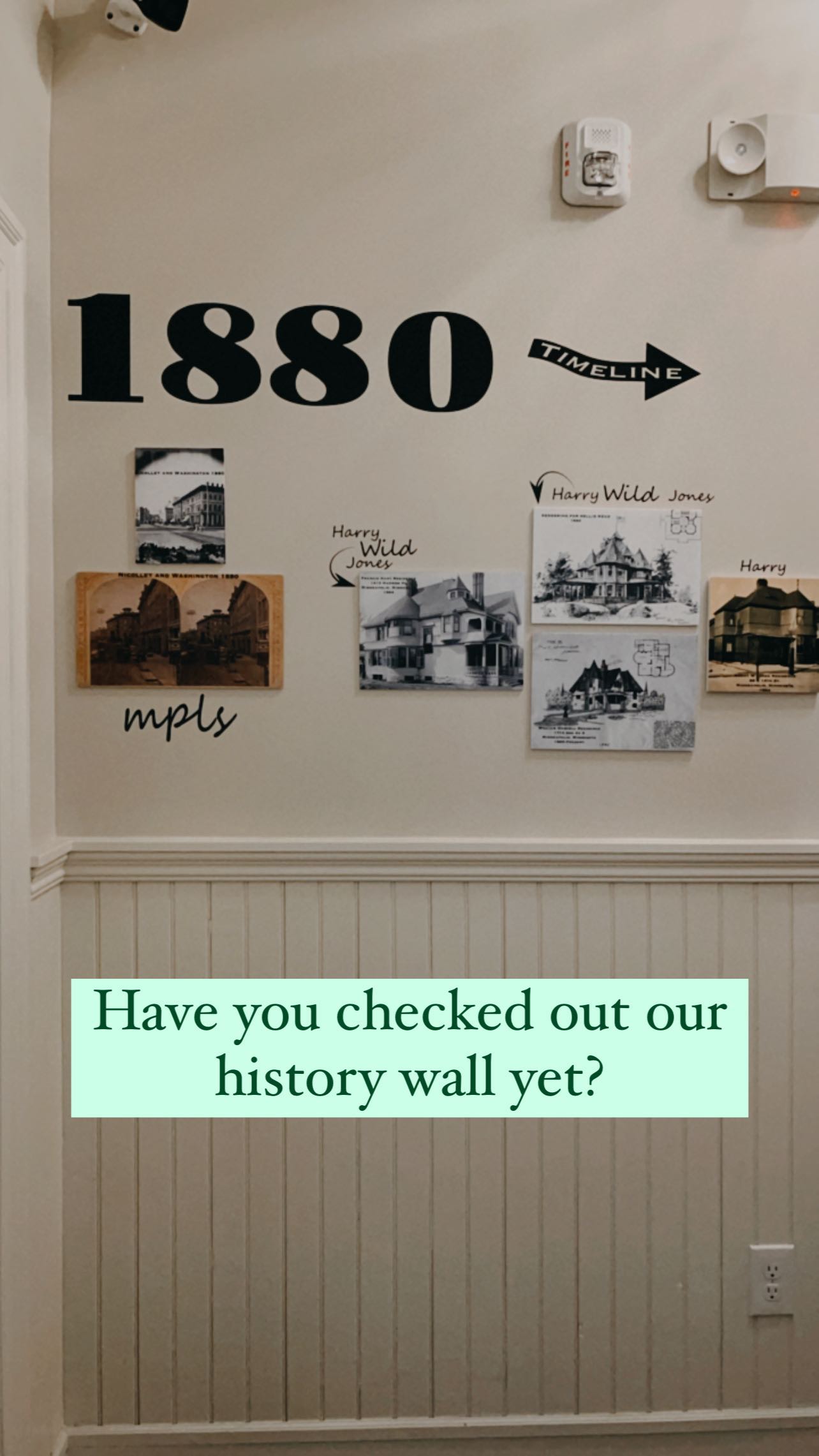
The restoration did not stop at the stone. Down the main hallways there is a history wall — a Minneapolis timeline that opens in 1880 and is hung with archival images of Jones’s other houses — designed with Liz Vandam, the historian who wrote the book on him. Guests staying a month tend to notice a new photograph on it every week.
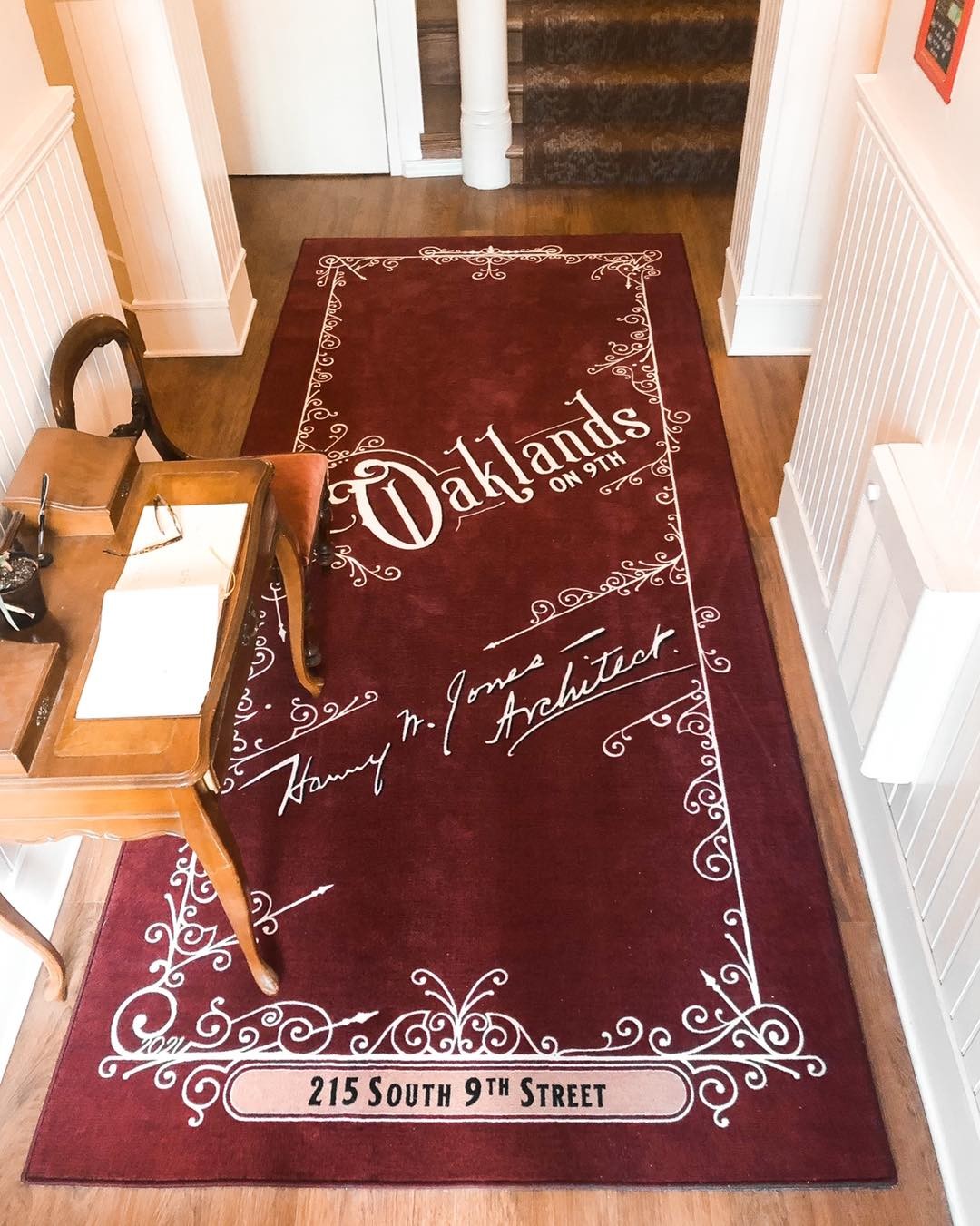
At the entry there is a deep red runner with the building’s name, the street address, and Harry W. Jones’s signature woven along the bottom. It was paid for, in part, by people who had followed the restoration and wanted the building’s architect credited at the door.
For the longer version of how the building survived, the Hennepin History Museum published an account of saving the Oakland. We have also written about the people who built and rebuilt it and the history you can see during a stay.
Stay inside the building, not just near it
Behind that 1889 front are fully furnished studios with full kitchens. WiFi, heat, all utilities, and laundry are included, there is no lease to sign, and you can stay a night, a week, or a month. Some studios are pet friendly. You are a short walk from the Skyway, Target on Nicollet Mall, Orchestra Hall, the Armory, Target Center, Target Field, and U.S. Bank Stadium — and close to HCMC if you are here for medical reasons or a travel-nurse contract.
If a historic stay is what you are after, our sister property 300 Clifton is an 1887 mansion bed and breakfast a mile south, and Minneapolis Trolley Tours will show you the rest of the city’s old stone and brick without the walking.
Come see the arch in person. Check dates and book a studio, or call us at (612) 314-5124 — we are happy to talk you through which tier fits your stay.
Keep reading: the 1889 front is only half the story — inside, every studio has a full kitchen. Here is where to buy groceries in downtown Minneapolis, starting four blocks west on 9th Street.