
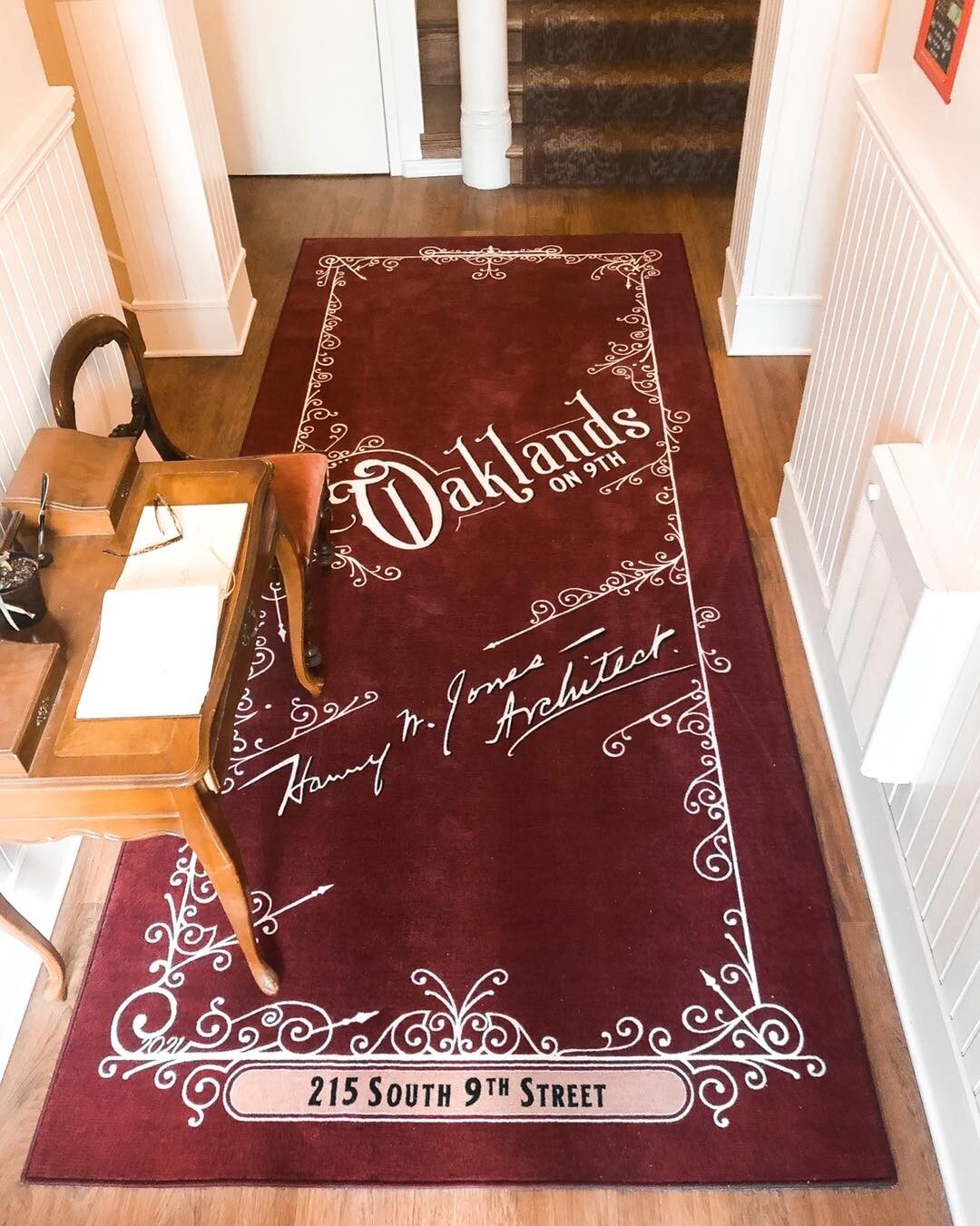
If you have ever walked through the front door at Oaklands on 9th, you have stepped right over his name. Woven into our entry mat, just beneath the Oaklands crest, is a signature: Harry W. Jones, Architect. It is a small, easy-to-miss detail—and it links our downtown Minneapolis studios to one of the most imaginative architects the city has ever known. Here is the story of the man who designed our building back in 1889, and what of his work you can still see (and stay in) today.
An 1889 brownstone on 9th Street
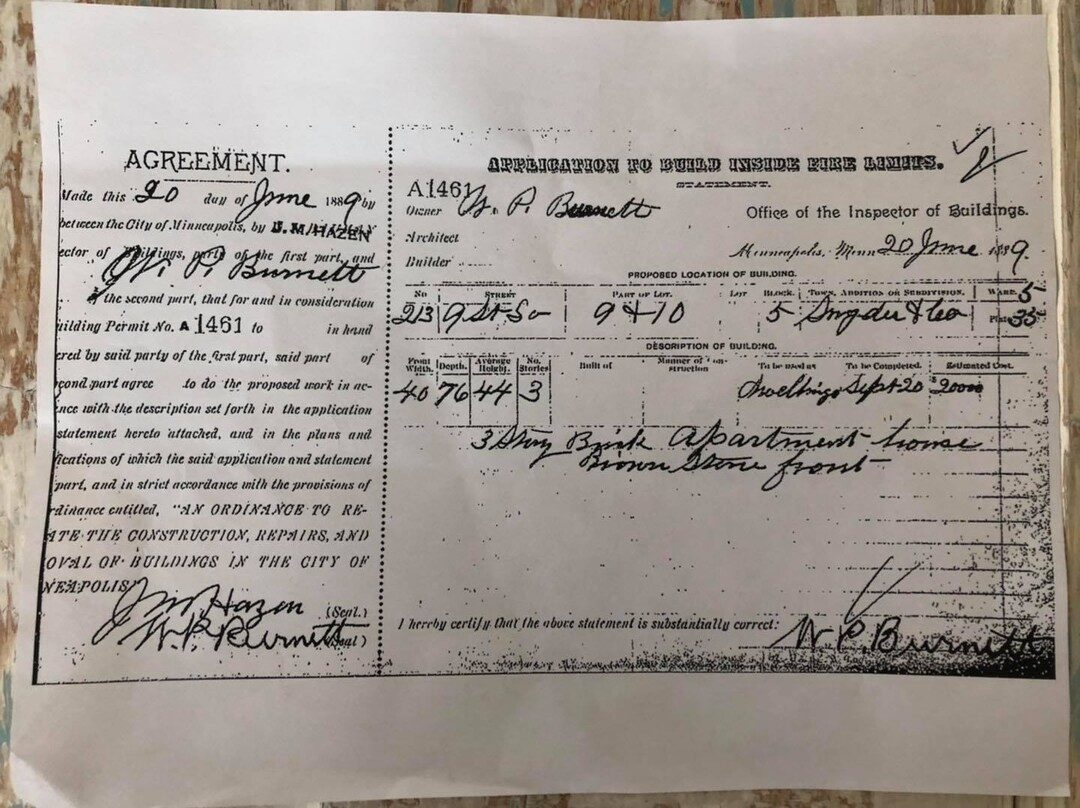
Oaklands began with a building permit pulled on June 20, 1889, by owner W. P. Burnett. The paperwork—a copy of which still hangs in the building—describes a three-story brick apartment house with a brownstone front, to be finished that September at a cost of $20,000. The architect listed on the project was Harry Wild Jones, then a rising young designer making a name for himself across Minneapolis.
More than 130 years later, that brownstone front still anchors our corner of South 9th Street, a few steps from the skyway, Nicollet Mall, and the heart of downtown. The building has lived many lives in between—luxury flats, the Delta Hotel, apartments again—but it has always carried Jones’s original lines.
Who was Harry Wild Jones?
Harry Wild Jones (1859–1935) trained at Brown University and MIT before settling in Minneapolis in 1883 and opening his own practice two years later. He is often credited with introducing the Shingle Style to the city, and he helped shape the next generation of designers as well, reorganizing the architecture program at the University of Minnesota and becoming one of its first formally trained instructors. His commissions reached well beyond Minnesota, but it is his hometown landmarks that most people know.
If his buildings feel familiar, that is because several of them are beloved local sights. Jones designed the soaring chapel at Lakewood Cemetery, modeled on a Byzantine church in Istanbul; the whimsical, castle-like Washburn Park Water Tower in the Tangletown neighborhood; and the Butler Brothers Warehouse, known today as Butler Square, in the Warehouse District. You can read more about his life and his far-flung body of work in his biography. For a building as everyday as an 1889 apartment house to have come from his drafting table is a quiet point of pride for us.
Living with his work today
By 2016, Jones’s brownstone had nearly been lost. A fire left it a roofless shell, and it sat open to three Minnesota winters before a determined restoration brought it back to life. You can read the full rescue story here, and see the original 1889 details still tucked inside—but the short version is that the grand staircase, the masonry, and much of the building’s character were carefully saved rather than replaced.
That is the part we love most. When you stay with us, you are not in a replica of something old—you are inside the real thing, warmed by modern heat, a full kitchen, and fast Wi-Fi, but still wrapped in Harry Wild Jones’s 1889 walls.
Stay in a piece of Minneapolis history
Our fully furnished, month-to-month studios put you in the middle of downtown—walkable to U.S. Bank Stadium, Target Center, Orchestra Hall, and the riverfront, and close to HCMC and the University of Minnesota Medical Center if you are here for work. Want to see more of Jones’s Minneapolis while you are in town? A loop on Minneapolis Trolley Tours is a fun way to take in the city’s historic architecture, and our sister property, the 300 Clifton mansion bed & breakfast, is another lovingly restored piece of local history. For even more ideas nearby, Meet Minneapolis keeps a great running list.
Keep reading: if you are planning a longer stay and bringing a dog or cat along, see our guide to pet-friendly extended stays in downtown Minneapolis.
Ready to settle in? Check rates and book your studio, or call us anytime at (612) 314-5124. We would love to host you in a building worth its place in the history books.